What scuba gear should you buy first? A PADI instructor in Batam breaks down the honest purchase order, including the one item most new divers forget.
Every new diver asks me the same question after their first open water dive. What should I actually buy?
It's a fair question. Dive shops sell everything from twenty-dollar snorkels to two-thousand-dollar dive computers, and nobody hands you a clear order to follow. Buy the wrong things first and you'll spend money on gear you could've just rented, while skipping something that actually matters for your safety and convenience.
I've taught PADI courses long enough to have watched this go wrong both ways. Students who buy a full gear set before their first dive, then realize half of it doesn't fit how they actually dive. And students who rent everything for years, then get frustrated with gear that never quite feels like their own.
Here's the order I recommend, based on what actually changes with more diving logs you clocked in.
Your mask is the cheapest important purchase you'll ever make in scuba diving. The best mask is the one that fits your facial profile. A rental mask that leaks, foggy, and poorly mantained can ruin an entire dive, and fit is completely personal. What seals perfectly on my face might flood constantly on yours.
When you're picking a mask, skip the color and go straight to fit. Put the mask on without the strap, inhale gently through your nose, and see if it holds to your face on suction alone. If it falls off or leaks air, that's not your mask.
A snorkel is a smaller decision. Match it to your mask attachment and don't overthink it. You'll use it far less than beginners expect once you're doing proper scuba dives instead of snorkeling trips.
Check: "How to Choose a Scuba Mask That Actually Fits Your Face"
A wetsuit that doesn't fit properly does two things badly. It lets in too much water, which means you lose warmth. And it throws off your buoyancy, which means you burn air faster fighting to stay level in the water.
Also, let's just be honest that at any point of a dive, one may pee in a wetsuit. While dive centers tends to rinse and disinfects it everytime, personally I would rather have my own.
Batam's water temperature makes a 3mm full suit or shortie a sensible starting point for most new divers, though this shifts depending on the season and which sites you're diving. If you're planning trips to cooler water later, like some southern Indonesian dive sites, you'll want to think about thickness differently than if you're only diving warm, shallow local reefs.
This is exactly the kind of decision where "which wetsuit" matters more than "wetsuit or not." I'll cover the differences between a shortie, a long suit, and various thickness options in a dedicated guide soon.
Check: "Wetsuit Guide: Shortie vs Long, and Choosing the Right Thickness"
Here's something I wish more instructors talked about early. A delayed surface marker buoy, or dSMB, is one of the most useful pieces of safety gear a new diver can own, and almost nobody buys one in their first year of diving.
A dSMB is a long inflatable tube you send up to the surface on a line, usually from the safety stop, to signal your position to any boats above. If you're diving anywhere with boat traffic, and most popular dive sites around Batam, Bintan, and the wider Riau Islands have exactly that, a dSMB tells surface boats exactly where you are before you surface. Without one, you're relying entirely on the boat operator's timing and a bit of luck.
It's also genuinely cheap. A basic dSMB costs less than a single dive trip, and once you know how to deploy one properly, it becomes second nature. I bring this up early with my own students because I'd rather they own one before their first trip beyond a guided course dive, not after a close call with a passing boat.
Check: "How to Deploy a dSMB: A Step-by-Step Guide for New Divers"
Fins get grouped with mask and snorkel as "ABC gear," but I'd actually put them after your wetsuit and dSMB on your buying list. Here's why. Fin choice depends heavily on your diving style, how you kick, whether you're diving in currents, and whether you're traveling with your gear or diving mostly local.
A pair of travel-friendly fins works completely differently from a set built for strong current diving. Buying fins too early, before you know your own diving habits, often means buying the wrong pair and replacing them within a year.
Rent a few different styles during your first several dives. Pay attention to which ones feel natural. Then buy once you actually know what you're choosing between.
Check: "Scuba Fins Compared: Paddle vs Split, Travel vs Performance"
A dive computer tracks your depth, dive time, and no-decompression limits in real time, and it's a genuine safety upgrade over relying purely on dive tables. That said, it's also one of the pricier items on this list, so I usually tell students to rent one for their first ten to twenty dives and buy once they know how often they'll actually be diving.
If you're planning regular dive trips, whether that's Batam's local sites or further out to Indonesia's better-known destinations, owning your own computer means you always know its settings, its battery history, and how it behaves. That familiarity matters more underwater than people expect.
Check: "Choosing Your First Dive Computer: What Actually Matters"
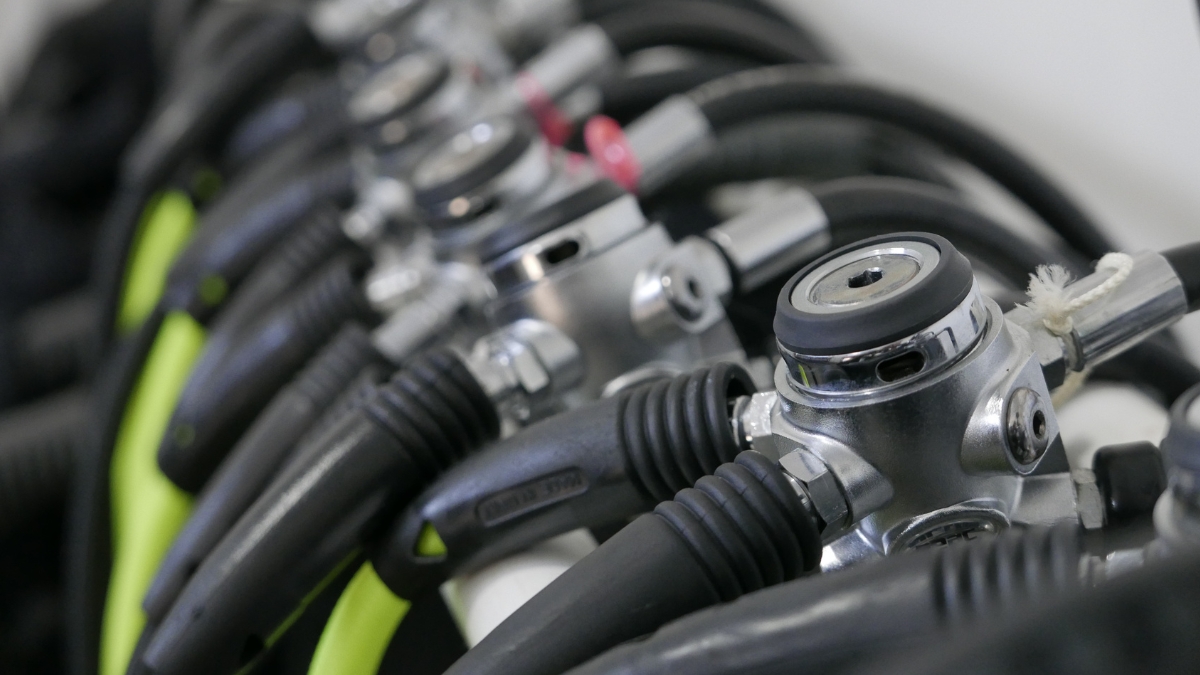
A regulator is the piece of gear you breathe through directly, which makes the hygiene and reliability argument for owning your own fairly strong on its own. It's also usually the single most expensive item on a beginner's gear list, so this tends to be a purchase people make once they're confident diving is a long-term hobby, not a one-off holiday activity.
If you're diving often enough that renting starts to feel like a hassle rather than a convenience, that's usually the right signal to buy.
Check: "Picking Your Regulator: It's Not As Simple As You Think"
A buoyancy control device is expensive, bulky to travel with, and highly personal in terms of fit. Most divers rent one for a long stretch before buying, and there's nothing wrong with that. By the time you're ready to buy a BCD, you'll already know your preferred fit, your typical dive style, and whether you want a travel-friendly version or something built for heavier use.
Check: "Get to Know BCDs: Jacket, Wings, Hybrid, Sidemount"
If you take one thing from this, let it be this order of thinking rather than the exact list. Buy the personal fit items first, mask, snorkel, wetsuit, because rental versions of these rarely fit well, plus hygine and comfort changes everything about how much you enjoy diving. Add a dSMB early, because it's cheap and it's genuinely a safety item, not a luxury. Then let fins, computer, regulator, and BCD follow as you figure out how often you're actually diving and what style suits you.
There's no prize for owning a full gear set on day one. I've taught plenty of divers who started with nothing but a rented set and a good attitude, and plenty who bought everything upfront and regretted half of it within a year.
If you're just starting your PADI Open Water course in Batam, we'll talk through exactly what you need to buy versus rent based on how you're diving. And once you're certified, this is exactly the kind of gear planning that matters before your first dive trip beyond Batam.
Book a course with Dive With Mikez or explore our PADI courses to get started.
I teach PADI courses in Batam with flexible scheduling for students coming from Singapore and Malaysia. Small groups, safety-first, taught in English, Bahasa Indonesia, and Mandarin.